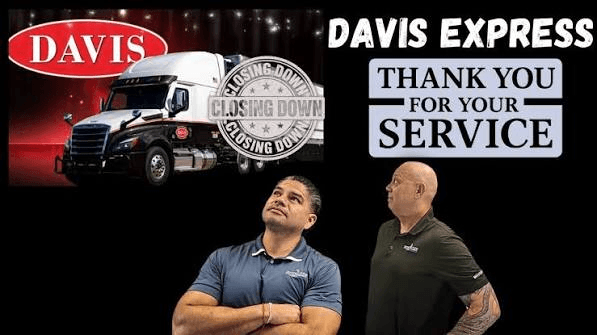
After more than four decades of refrigerated trucking in Florida, Davis Express has confirmed it will permanently cease operations. The closure affects over 160 employees, removes one of Bradford County’s largest employers from the local economy, and leaves shippers across the Southeast searching for alternative carriers.
This article covers what is confirmed, why the company is closing, what it means for employees and customers, and what this event reflects about the current state of the trucking market.
Davis Express Is Shutting Down — Here Is What Is Confirmed
Davis Express, a family-owned refrigerated carrier based in Starke, Florida, has announced it will permanently close after more than 44 years in business. This is not a bankruptcy filing, and it is not a restructuring. The company is conducting a voluntary, orderly wind-down of its operations.
According to available reports, the company has sufficient reserves to pay off its debts and fulfill its financial obligations to employees during the transition. Final deliveries were scheduled around April 23, 2025, with all trucks and equipment returned to headquarters by April 30, 2025. All 163 employees are set to receive pay and benefits through mid-June 2025.
The closure is structured and planned — not a sudden collapse. That distinction matters both for employees managing the transition and for shippers who need time to arrange alternative freight coverage.
A 44-Year Business in Starke, Florida — Company Background
Davis Express was founded approximately 44 years ago and grew into one of Bradford County’s most significant employers. The company operated around 160 power units, employed roughly 140 drivers, and had a total workforce of approximately 163 people, including office staff and mechanics.
The company specialized in refrigerated, or temperature-controlled, freight. This is a demanding segment of the trucking industry. It requires specialized equipment, precise temperature monitoring, and a higher level of operational discipline compared to standard dry freight hauling.
For Bradford County, Davis Express was more than just a trucking company. It was an economic anchor. Losing an employer of that scale has consequences that reach well beyond the company itself — affecting local spending, small businesses that served its workforce, and the county’s overall tax base.
Why Davis Express Is Closing — Financial Losses, Market Conditions, and a Succession Gap
The closure was not caused by a single event. It resulted from a combination of factors that, taken together, made continuing operations unsustainable.
Sustained Financial Losses
Davis Express has been operating at a loss since early 2023. During that period, freight rates softened while operating costs continued to rise. Fuel, insurance, and maintenance expenses all increased, while the income side of the business — freight rates — stagnated or declined.
Think of it like a household budget where the bills keep going up but the paycheck stays flat. A household can absorb that for a period, but not indefinitely. Davis Express held on for more than two years before the decision to close was made.
Owner Retirement and No Succession Path
Compounding the financial pressure, owner Jimmy Davis decided to retire. The next generation of the Davis family has no interest in taking over the business. That eliminated any internal succession path.
This is a challenge that many family-owned businesses face, and trucking companies are no exception. Consider a well-regarded family restaurant with a loyal customer base. If the owner wants to retire, margins are thin, and no family member wants to take the reins, the most responsible decision may simply be to close — rather than sell under unfavorable conditions or continue operating at a loss.
The convergence of ongoing financial losses and no willing successor made closure the logical outcome. Neither factor alone may have been decisive, but together they left little room for any other path.
The Freight Recession and Its Effect on Mid-Size Carriers
Davis Express is not an isolated case. The U.S. trucking industry has been navigating a prolonged freight recession since 2023, and mid-size carriers have been among the hardest hit.
What the Freight Recession Looks Like
The freight recession is characterized by excess capacity in the market, soft demand for shipping services, volatile spot rates, and persistent upward pressure on operating costs. When there are more trucks available than freight to move, carriers are forced to accept lower rates to keep their trucks running. Lower rates combined with higher costs is a difficult equation to solve.
Large national fleets can often weather these cycles through scale, diversified revenue streams, and greater negotiating power with shippers. Smaller owner-operators have lean cost structures that give them flexibility. Mid-size carriers — those operating roughly 100 to 300 trucks — often find themselves in the most vulnerable position. They carry significant fixed costs without the scale advantages that larger fleets enjoy.
Refrigerated Carriers Face Additional Pressure
Operating a refrigerated fleet adds another layer of cost. Reefer equipment is more expensive to purchase and maintain than standard dry van trailers. Temperature monitoring systems, more frequent maintenance intervals, and the complexity of temperature-sensitive freight all add to overhead.
When freight rates decline across the board, refrigerated carriers feel it acutely. Their cost base is higher, which means their margins compress faster when rates fall.
Davis Express fits a documented pattern. Its closure is consistent with a broader wave of mid-size carrier exits that have occurred during this freight cycle. That does not mean the entire trucking industry is in crisis — it means a specific segment of the market is under serious pressure, and some carriers will not survive the cycle intact.
What This Means for Employees and the Local Community
Approximately 163 workers are affected by the closure, including truck drivers, office staff, and mechanics. The company’s approach to the wind-down has given employees more runway than many sudden closures allow. Pay and benefits extending through mid-June 2025 provides workers several weeks to pursue new opportunities after operations cease at the end of April.
For drivers specifically, the regional trucking job market remains active. Other carriers operating in Florida and the Southeast will likely absorb some of the displaced drivers, though the transition will still be disruptive for families and households that depended on Davis Express for steady employment.
For Bradford County, the impact is broader. When one of a county’s largest employers closes, the effects ripple through local businesses, service providers, and the community’s overall economic activity. The loss has been described in local coverage as “heartbreaking,” which reflects the reality of what a 44-year employer means to a community of that size.
What Shippers and Customers Should Know
For businesses that relied on Davis Express for refrigerated freight in the Southeast, the immediate priority is securing alternative carrier relationships. When a carrier exits the market, its freight does not disappear — it shifts to other providers. Acting quickly to identify and qualify replacement carriers reduces the risk of service gaps.
This closure is also a useful reminder about carrier diversification. Relying heavily on a single carrier — particularly a regional one — creates exposure when that carrier’s circumstances change. Shippers who maintain relationships with two or more qualified refrigerated carriers are better positioned to manage disruptions like this one.
The trucks and equipment from Davis Express are expected to return to headquarters by April 30, 2025, and will likely be sold or redeployed through auctions or acquisitions by other fleets. That equipment re-entering the market adds capacity elsewhere, which may provide some relief for shippers looking to fill the gap.
What Other Carriers and Business Owners Can Learn
The Davis Express closure offers a clear illustration of how market cycles and internal business factors can intersect with significant consequences. A few lessons stand out for carriers and family-owned businesses in similar positions.
For those looking to stay informed about business developments like this one, resources like Inpage Business provide ongoing coverage of industry trends and company news that can help owners and operators make better-informed decisions.
- Succession planning matters. A business without a clear succession plan is more vulnerable when the founder decides to step back. Identifying and preparing a successor — whether from within the family or outside it — should happen years before it becomes urgent.
- Extended losses require early action. Operating at a loss for more than two years before making a major decision compresses the options available. Carriers facing sustained margin pressure benefit from evaluating their position earlier, while more alternatives still exist.
- Market cycles are real and cyclical. Freight markets move in cycles. Mid-size carriers that build financial reserves during strong periods are better equipped to endure downturns without being forced into closure.
Final Assessment
Davis Express is going out of business. That is confirmed. After more than 44 years as a refrigerated carrier and a cornerstone employer in Bradford County, Florida, the company is conducting an orderly shutdown — not a bankruptcy, not a restructuring, but a planned and responsible closure.
The reasons are straightforward: sustained financial losses since early 2023, a freight market that has remained difficult for mid-size carriers, rising operating costs, and an owner who chose to retire without a successor ready to take over. No single factor tells the full story; it was the combination that made closure the most rational decision.
For the 163 employees affected, the transition will be challenging. For Bradford County, the economic loss is significant. And for the broader trucking industry, the Davis Express closure is another data point in a difficult cycle that continues to reshape the competitive landscape for regional and mid-size carriers.
Read This: